FSH Online, Semarang, Indonesia — Representation is an important step towards inclusion, but it does not automatically guarantee that people can influence the decisions affecting their lives. Meaningful inclusion also requires the opportunity to speak, be understood, and participate in shaping public policy.
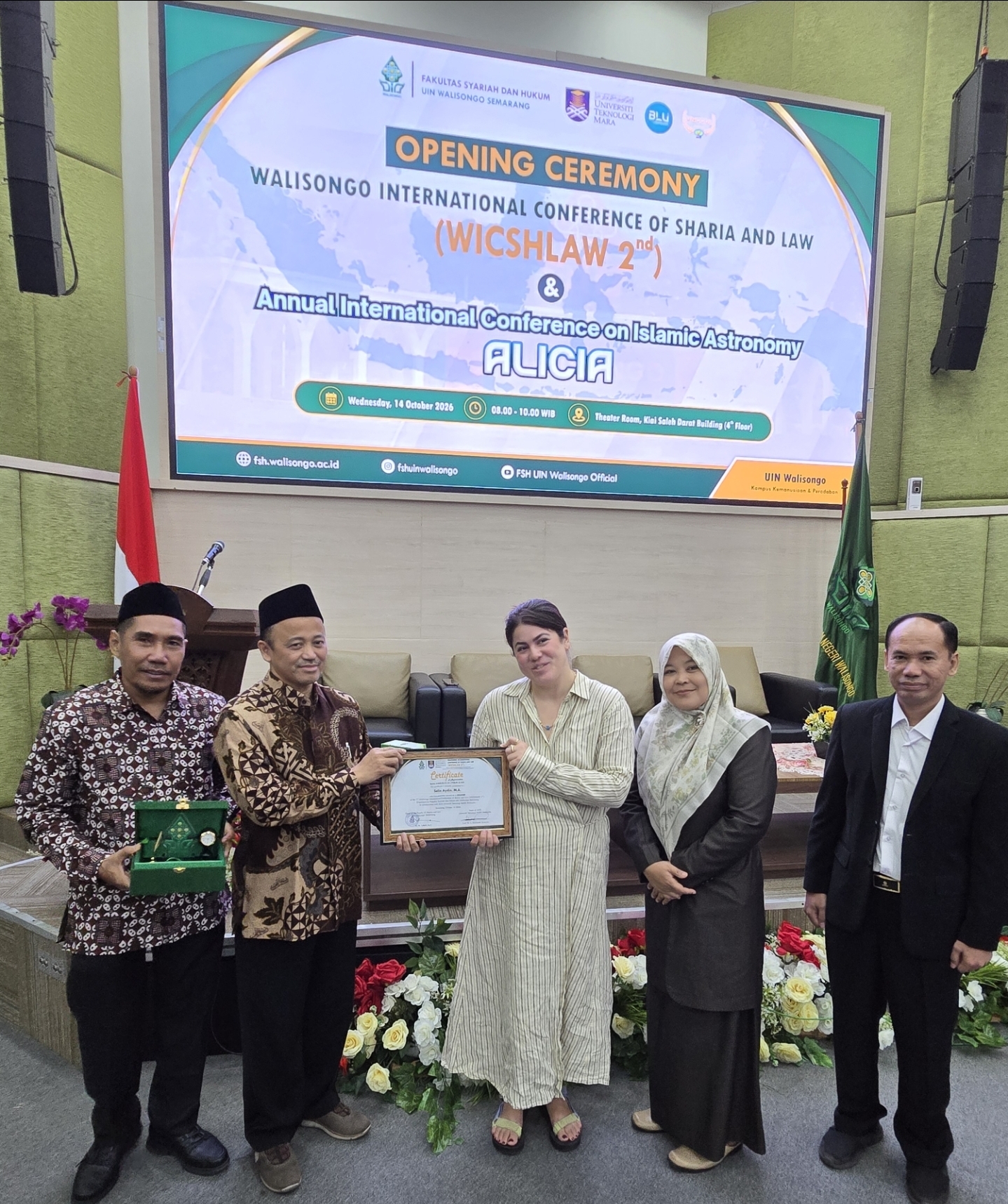
That idea formed the focus of a discussion at the second Walisongo International Conference of Sharia and Law (WICSHLAW 2nd), held on Wednesday, 14 October 2026, at UIN Walisongo Semarang. The conference brought together 150 students to explore how Sharia and legal institutions can respond to a world reshaped by geopolitical shifts, economic transformation, and artificial intelligence.
Selin Aydin, M.A., Chief of Staff and Policy Advisor at the House of Representatives in Berlin, Germany, delivered a presentation on inclusion and participation. The central message of her topic was clear: inclusion is not only about being represented; it is also about being heard, understood, and having the power to participate.
The distinction matters because representation can become symbolic when individuals or groups are present in a decision-making forum but lack meaningful influence over its outcomes. Genuine participation requires more than visibility. It depends on whether people can express their concerns, access relevant information, and contribute to decisions in ways that are taken seriously.
These questions are relevant to legal institutions, public administration, and democratic governance. Laws and policies can affect different communities in different ways. A decision-making process that listens only to the most influential voices risks overlooking the experiences of people whose needs are less visible.
The challenge becomes more complex in a rapidly digitising world. Artificial intelligence and digital platforms are changing how information is distributed, how public services are delivered, and how people engage with institutions. Such technologies can widen access, but they can also create barriers when systems are difficult to understand, inaccessible, or insufficiently responsive to diverse needs.
Against this backdrop, inclusion should be considered not merely a public-relations objective but a principle of institutional responsibility. Public institutions need processes through which people can contribute, raise concerns, and understand how decisions are made. Participation must be meaningful enough to connect public voices with institutional action.
WICSHLAW 2nd was officially opened by Prof. Dr. H. Imam Yahya, M.Ag., Vice Rector I of UIN Walisongo, as keynote speaker. Dr. H. Tolkah, M.A., Dean of the Faculty of Sharia and Law, delivered the welcoming remarks.
The conference’s main theme, “Sharia in a Disruptive World: Navigating Geopolitical Shifts, Economic Transformation, and Artificial Intelligence for Global Sustainability,” provided a broader framework for examining the relationship between law, social change, and public responsibility.
Other speakers included Prof. Madya Datin Dr. Rafeah Saidon of Universiti Teknologi MARA, Malaysia, who discussed Islamic family law in a changing world, and Prof. Dr. Muhyar Fanani, M.Ag., of UIN Walisongo’s postgraduate programme, who examined the integration of Sharia values into Indonesia’s legal system.
For the 150 participating students, the discussion offered an opportunity to consider law beyond written rules and formal representation. It raised a practical question for future lawyers, policymakers, and public officials: do institutional processes simply allow people to be present, or do they give people a genuine opportunity to shape decisions?
As societies become more diverse and technology increasingly mediates public life, meaningful inclusion remains essential to building institutions that are responsive, accountable, and trusted.