FSH Online, Semarang, Indonesia — Islamic astronomy is entering a new phase in which traditional calculations can work alongside automated systems, computational models, and digital observation technologies. The transition offers opportunities to improve efficiency and consistency while preserving the scientific and religious foundations of ilmu falak.
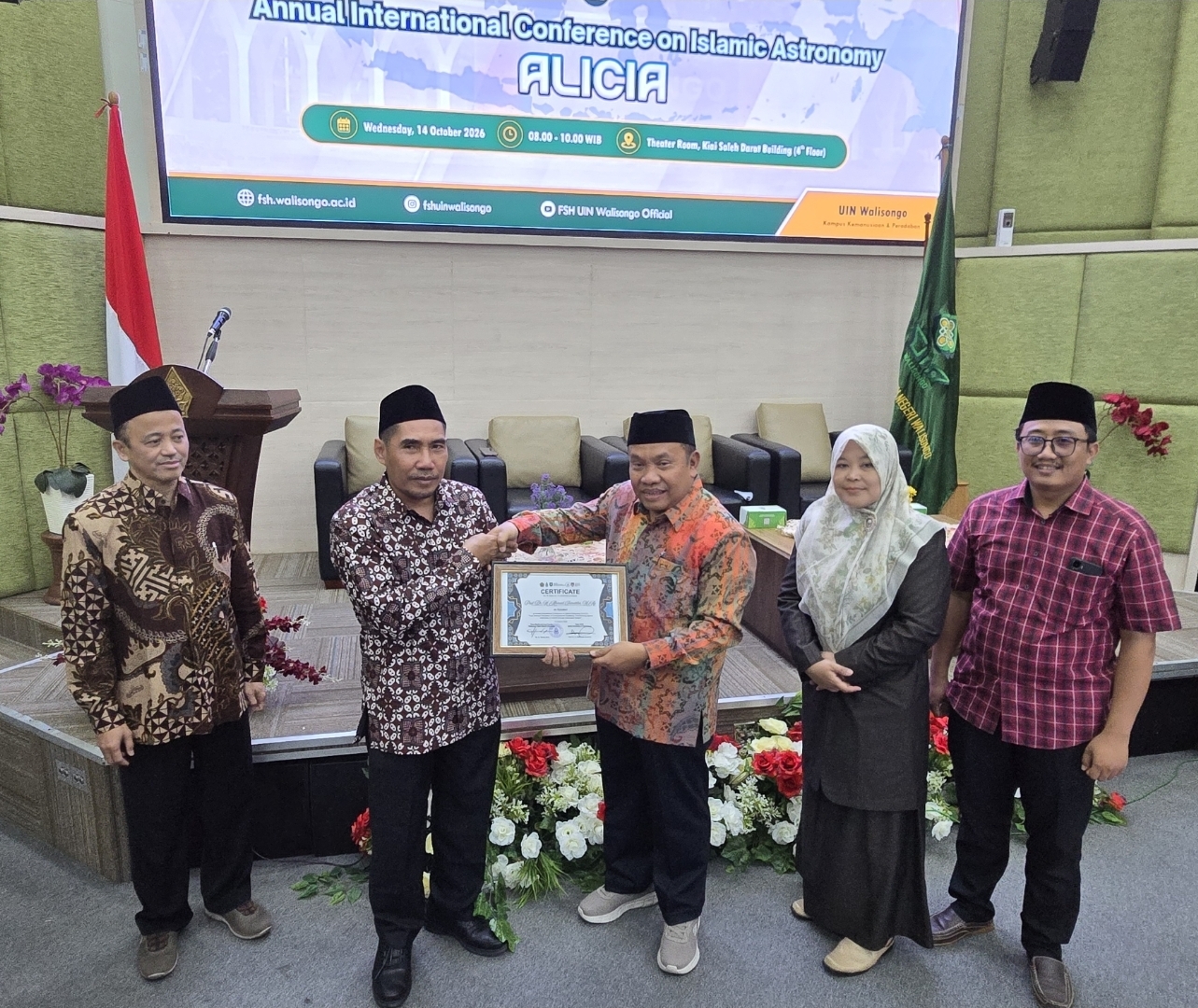
This transformation was a central theme of the Annual International Conference on Islamic Astronomy (ALICIA), held on Wednesday, 14 October 2026, at the IsDB Theatre Hall, Faculty of Sharia and Law, UIN Walisongo Semarang. The conference brought together 157 students to explore how Islamic astronomy can respond to technological change across the ASEAN region.
The event was officially opened by Prof. Dr. H. Imam Yahya, M.Ag., Vice Rector I of UIN Walisongo, as keynote speaker. Dr. H. Tolkah, M.A., Dean of the Faculty of Sharia and Law, delivered the welcoming remarks.
The conference’s main theme, “From Manual Calculation to Computational Excellence: Transforming Islamic Astronomy in ASEAN through Automated Systems,” highlighted the growing importance of digital technology in astronomical research and its practical applications in Muslim life.
Prof. Dr. H. A. Izzuddin, M.Ag., Professor of Islamic Astronomy and Head of the Doctoral Programme in Islamic Studies at UIN Walisongo, presented a topic sharing the conference’s central theme. His area of expertise reflects the longstanding relationship between Islamic scholarship, mathematical calculation, and astronomical observation.
Islamic astronomy supports several essential religious practices, including determining prayer times, calculating the direction of the Qibla, and establishing the beginning of Hijri months. These tasks require accurate astronomical data, reliable mathematical methods, and careful interpretation of results.
Automated systems can help process complex calculations more efficiently and make astronomical information easier to analyse. Digital image enhancement, computational modelling, and remote telescope networks also offer new ways to support observations of the crescent moon, or hilal. Such tools are particularly relevant in Southeast Asia, where weather conditions, atmospheric clarity, and geographical differences can affect observations.
UIN Walisongo’s published ALICIA 2026 programme identifies several related research priorities, including automated astronomical observation, digital optimisation of hilal images, computational approaches to the Hijri calendar, and the integration of classical Islamic scholarship with modern technology.
These developments do not mean that traditional methods have lost their value. Rather, they raise a more important question: how can established knowledge and modern computational tools complement one another? Reliable systems still depend on sound astronomical models, validated data, transparent procedures, and an understanding of the religious and scientific context in which calculations are used.
The conference also featured Mr. Mohd Razlan Bin Ahmad, a lecturer in Islamic Astronomy at the Academy of Contemporary Islamic Studies, Universiti Teknologi MARA, Malaysia, who discussed digital integration in Islamic astronomy education. Judhistira Aria Utama, from the Earth and Space Education, Exploration, Mitigation and Protection research group, addressed the relationship between computational tolerance and the physical reality of observing the Sun.
Together, the topics connected technological innovation with education and the limits of astronomical measurement. They also highlighted the importance of regional academic collaboration in developing systems that can be tested, evaluated, and adapted to different observing conditions.
For the next generation of falak scholars, the challenge is not simply to replace manual calculations with software. It is to understand the science behind the tools, evaluate their reliability, and use technological progress to strengthen the accuracy and accessibility of Islamic astronomy.