FSH Online, Semarang, Indonesia — Digital technology is changing how astronomy is taught, studied, and applied. In Islamic astronomy, the transformation has particular significance because students must connect scientific concepts with practical questions such as prayer times, Qibla direction, and the determination of the Islamic calendar.
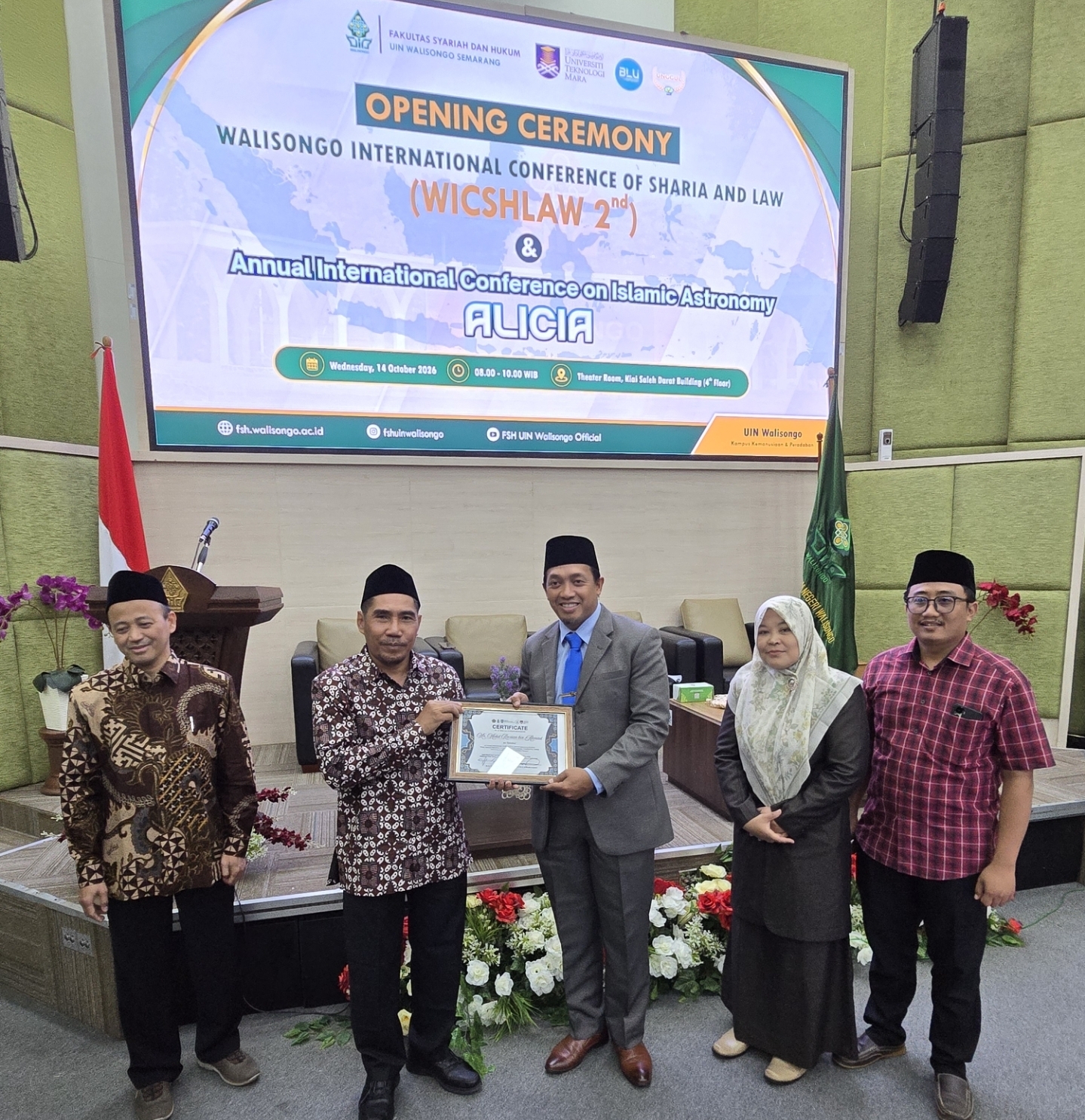
These issues formed the context of the Annual International Conference on Islamic Astronomy (ALICIA), held on Wednesday, 14 October 2026, at the IsDB Theatre Hall of the Faculty of Sharia and Law, UIN Walisongo Semarang. The event attracted 157 students and explored how digital systems could transform Islamic astronomy across Southeast Asia.
The conference was officially opened by Prof. Dr. H. Imam Yahya, M.Ag., Vice Rector I of UIN Walisongo, as keynote speaker. Dr. H. Tolkah, M.A., Dean of the Faculty of Sharia and Law, delivered the welcoming remarks.
One of the featured speakers, Mr. Mohd Razlan Bin Ahmad, a lecturer in Islamic Astronomy (Falak) at the Academy of Contemporary Islamic Studies (ACIS), Universiti Teknologi MARA (UiTM), Malaysia, presented “Digital Integration in Islamic Astronomy Education in Malaysia.”
His topic addressed an increasingly relevant challenge for higher education: how can digital tools become part of meaningful learning rather than simply another layer of technology?
In Islamic astronomy, students need to understand both the theoretical foundations and the practical application of astronomical methods. Digital resources can support this process through simulations, computational exercises, visualisation tools, and access to astronomical data. These approaches may help students connect mathematical calculations with observable phenomena in the sky.
UiTM’s published curriculum for its Introduction to Islamic Astronomy course illustrates this practical orientation. The course connects astronomical knowledge with worship-related applications, including prayer times, Qibla determination, and the Islamic lunar calendar. Its listed teaching methods include practical classes, field trips, simulations, case studies, and problem-based learning.
This approach points to an important principle in digital education: technology is most useful when it helps students understand, test, and apply knowledge. Software can accelerate calculations, but students still need to understand the assumptions behind the results, recognise potential errors, and explain why a particular method is appropriate.
Research published in the Journal of Contemporary Islamic Studies in 2023 by Mohd Paidi Norman, Muhamad Syazwan Faid, Nur Nafhatun Md Shariff, and Mohd Razlan Ahmad also examined the importance of Islamic astronomy education in addressing light pollution from the perspective of maqasid al-shariah. The work illustrates how falak education can extend beyond calculations to wider scientific, environmental, and ethical concerns.
Digital integration can also create opportunities for collaboration across institutions and national borders. Shared learning resources, online discussions, and coordinated observation projects can help students compare methods and examine how geographical and atmospheric conditions influence astronomical observations.
At the same time, digital learning requires careful implementation. Students need access to appropriate tools, reliable data, effective teaching guidance, and opportunities to engage directly with astronomical phenomena. Without these elements, digital platforms risk becoming passive sources of information rather than instruments for deeper understanding.
ALICIA 2026 brought these educational questions into a broader regional conversation under the theme “From Manual Calculation to Computational Excellence: Transforming Islamic Astronomy in ASEAN through Automated Systems.”
The programme also featured Prof. Dr. H. A. Izzuddin, M.Ag., Professor of Islamic Astronomy at UIN Walisongo, and Judhistira Aria Utama, a researcher in Earth and Space Education, Exploration, Mitigation and Protection.
Their contributions connected computational development with the scientific realities of observation, reinforcing the importance of combining technological competence with a strong understanding of astronomical principles.
For universities, the next step is to ensure that digital integration develops students’ analytical abilities, practical skills, and scientific judgement. In Islamic astronomy, successful digital education means preparing learners not merely to operate software, but to understand the sky and apply their knowledge responsibly.